
I am an uncertainty addict. Maybe that’s a lie.
From tangled problems to clear action—my three-step fix.

Good Monday!
Deezer’s algorithm did something interesting—it surfaced “Not an Addict” by K’s Choice, a 30-year-old song I used to love for the melancholy. The song is about denial and the stories we tell ourselves; this time, one line stuck with me: “Maybe that’s a lie.”
Lately, I’ve been reflecting on my relationship with uncertainty. Am I really an uncertainty addict, or is that just the story I tell myself to justify always choosing the road less traveled?
Let’s look at the evidence: I keep picking projects with no guaranteed outcome. I explored in-car delivery as a corporate innovator. At 40, I quit my corporate job to see if I finally wanted to become a full-stack coder. Then I founded a company to build something valuable. Across my career, I’ve used foresight methods—imagining and preparing for different outcomes. What if this? What if that?
Here’s what I’ve learned: exploring uncertainty, while uncomfortable, is more honest than clinging to the illusion of control. I’m always amazed at how project managers and CEOs rely on fake precision (hello, cost projections seven years out, with two decimal places, for a single scenario).
I prefer uncertainty because it feels safer than fake precision.
Take it from an Addict
If you’re reading this, maybe you—or someone you know—is stuck in analysis paralysis, hoping for a secret method to make uncertainty vanish.
Spoiler: I have no secret method. I love structure and clear answers as much as anyone.
But here’s what I’ve learned: by following uncertain paths, I’ve actually gained clarity. I accept what I don’t know, gather information, make decisions, discover what I still don’t know, repeat.
Deciding not to decide—and waiting for uncertainty to dissolve—is still a decision. It rarely gets you where you want to go.
How to embrace uncertainty?
A lot of paralysis comes from tangled problems. We don’t know where to start. Here’s an approach I’ve used for years—just recently applied when a risk became reality and one certainty splintered into many uncertainties.
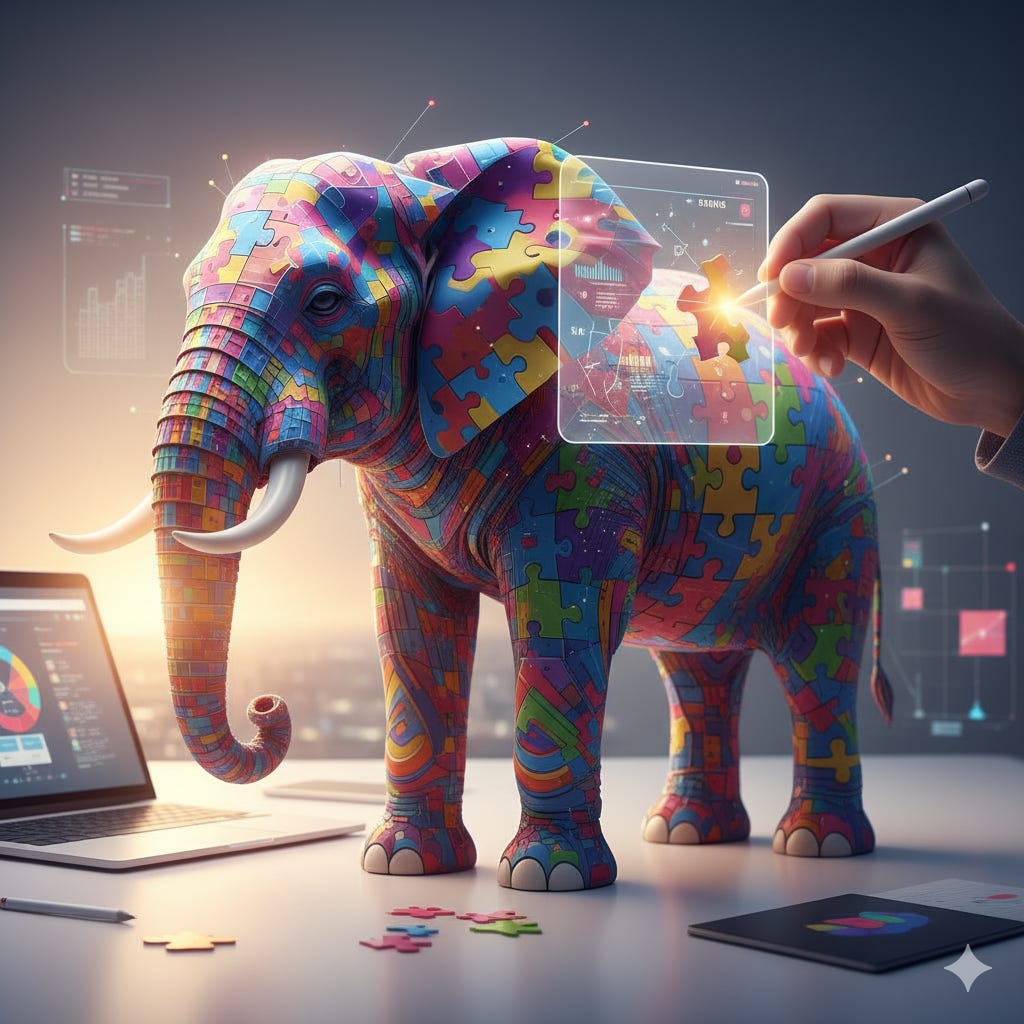
Eat the Elephant: Write down what you actually know
Include knowns and known-unknowns. Example: “Our HQ stays in (City).” “I know that I don’t know how to (specific thing).”
Quality Check: Is this true?
Challenge each line. Is it really true? Is it actually a problem? Mark three that feel both uncertain and consequential.
Travel to the Future: Find (Early) Adopters.
Science fiction author William Gibson said, “The future is already here—it’s just not very evenly distributed.” This underpins Futures Literacy: the ability to use the future to better frame the present. Chances are, someone else is already living your uncertainty, meaning they already have your problem or are following a dream. Don’t keep predicting—test your assumptions. Wondering how AI will impact your field? Find someone with a first use case and ask: What was it like at the start—and what’s it like now?
This three-step approach won’t eliminate uncertainty, but it brings clarity and turns guessing into research, providing the actionable data required for effective change.
The Future of AI in Music
Speaking of making decisions without perfect information: The AI music debate is everywhere and I’ve been watching how platforms like Spotify and Deezer handle it.
Both face the same foggy future around AI and creators’ rights. The rules are unclear. The questions—what’s the value of art, can AI be creative, what will customers pay for—are unresolved. The tech outruns the debate.
But the platforms made different choices.
Deezer took a stand: AI detection tools, a global statement against unlicensed AI training, labeling AI-generated music, and removing it from recommendations. They’re actively protecting artists’ revenues from fraudulent AI streams.
Spotify? They made a clear decision: maintaining neutrality and handling AI music “on a case-by-case basis.” They have now essentially been forced to retract that policy.
I chose Deezer with my wallet. Not because I knew their approach will “win” or that it solves all questions. But in an uncertain landscape, I’d rather support a company making thoughtful, value-driven decisions than one waiting for perfect information. Moreover, given the already vast distribution of AI spam and low-effort content across the web, this was a highly likely trend that Deezer recognized early. Spotify reported they had to remove over 75 million spam tracks over the past year. For context, their actual catalog is around 100 million tracks.
Not addicted, but allergic
So am I really an uncertainty addict? Maybe that is a lie. I’m actually allergic to fake precision and decision paralysis.
Seeking uncertainty is my antidote—it helps me test assumptions and make better decisions.
What’s your current elephant? Hit reply and tell me. Maybe I’ll share mine.
I enjoyed reading your article, Stella. I too prefer truth over uncertain 'prediction'. So far, reading the future is only for the clairvoyant 🔮 whether or not their readings are true or good depends on many factors.😇
For a long time I struggled to accept AI as a sparring partner. But a lot of people on Substack apply it in valuable ways. So I've drafted this method in an "Eat the elephant" prompt. My goal: untangle my problems and identify my three most consequential uncertainties. Then I find someone who's already lived through this exact situation, armed with my better questions.
I still fear AI will change human interaction in a bad way. Yet I feel it can make my human conversations sharper—I show up with better questions to the right people.
Here's to healthy human-AI-cooperation.
See below for the prompt. Would love to hear how it works for you.